Ebook · By Dr. Saurabh Bhatia, MBBS, MS, FCR

Use It to
Lose It

A Doctor's Method to Reverse Diabetes and Lose Weight Without Meds

Think of this book as one long consultation. It speaks to you as a patient sitting across the table, because that is exactly how it was written: plainly, and without scare tactics.

Ebook. The download becomes available automatically once your payment is complete.

This book is general education, not a consultation. Please do not start, stop or change any medicine because of something you read; review it with your own doctor first.

A woman in a maroon and gold saree holding a copy of the book Use It to Lose It at a book launch
Illustrative image
01 / Watch first

A taste of the book

Two short pieces on ideas from the book. Press play to watch here.

PodcastBMI Was Invented by an Astronomer. Here’s What to Measure Instead
Video overview · EnglishYour BMI Is Lying: Why Indians Are Overweight at 23, Not 25
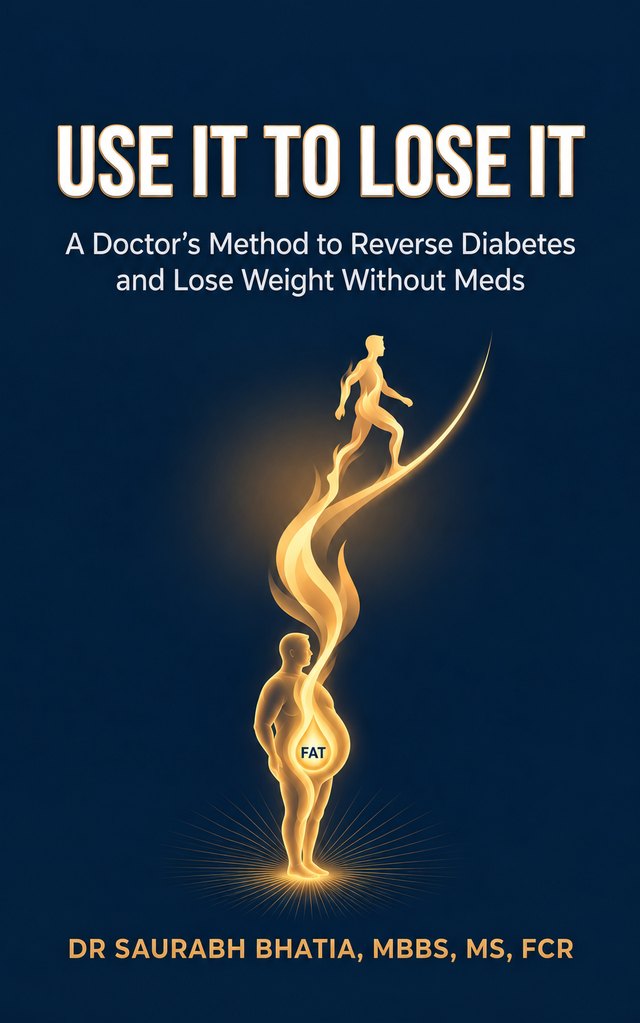
Cover of the book Use It to Lose It by Dr. Saurabh Bhatia, MBBS, MS, FCR, showing a glowing figure walking up from a heavier silhouette on a deep blue background
02 / What the book does

A plan you can actually follow

It begins by questioning two labels you may have been given, "overweight" and "diabetic", and then explains the tools and tests you will need. After that it looks at what you actually eat, why Indian bodies carry fat differently, and why belly fat is the real villain.

Then it builds your plan around awareness, food, the timing of meals, exercise, stress and a calmer mind, and prepares you for what to expect and for sustaining the change for life.

  • Whether the labels "overweight" and "diabetic" really describe you
  • Which home tools and lab tests you need, and how to read your own numbers
  • Why Indians fall sick at lower weights, and what belly fat is really doing
  • What cure, remission and reversal actually mean, and what success looks like
  • A daily plan for food, meal timing, movement, stress and the mind
  • 34 chapters in 9 parts
  • Food workbook included
  • References for every chapter
  • Safety note on medicines
03 / Peek inside the book

All 34 chapters, in brief

Open a part to see what each chapter covers. Page numbers are from the ebook.

Part 1Are you really the problem you think you are?3 chapters
1

Are You Sure You're Overweight? p. 10

Starts by questioning the number most of us trust. You learn where BMI came from (a 19th-century statistician describing crowds, not diagnosing individuals), why Indian bodies need different cut-offs, with overweight starting at a BMI of 23 and waist size as a second check, and which better measures show what is really going on.

2

Do You Also Have Diabetes? p. 20

Gives the diabetes label the same scrutiny. It covers the four official ways diabetes is diagnosed, why a diagnosis normally needs confirming, when a single reading can mislead, and why blood sugar is the smoke rather than the fire. It ends with the questions worth taking to your own doctor.

3

What Your Medicines Are Actually Doing to You p. 28

Explains in plain language the job each common diabetes medicine does in your body, from metformin and gliptins to sulfonylureas, SGLT2 inhibitors and GLP-1 drugs. You see what each one borrows against, and why controlling a number is not the same as reversing the problem. The advice throughout: take your medicines as prescribed and never stop one on your own.

Part 2Before we begin2 chapters
4

The Instruments You'll Need p. 38

The few simple tools worth having at home: a glucometer, a weighing scale used properly and a measuring tape, with a CGM and a body composition monitor as optional extras. For each, you learn what it tells you, how often to use it, and what not to be impressed by.

5

The Lab Tests I Want Before You Start p. 46

Why a baseline matters before you begin. The chapter covers the tests that matter most, including HbA1c and fasting insulin, and what each says about fat as well as sugar. It also explains how the baseline protects you from mistaking a temporary improvement for real reversal.

Part 3Let's talk about what you eat5 chapters
6

A Workbook: What Do You Actually Eat? p. 54

A hands-on food diary. You learn how to record what you really eat without cheating yourself, with a template to use, and what to notice besides calories. Nothing is changed in this chapter; the aim is simply to see your own eating honestly.

7

The Role of Protein p. 60

Why many Indian diets are quietly short on protein, and why that matters. It explains how protein keeps you full, protects muscle while you lose fat and helps blood sugar, with practical ways to get more of it without turning into a gym fanatic.

8

What About Sugar and Carbs? p. 68

Sugar is not the same as carbohydrates, and carbohydrates are not all the same. The chapter looks at speed, fibre and portion size, why the Indian plate makes the problem bigger, whether you really have to give up rice and roti, and where the real damage happens.

9

Did We Forget Fats and Salt? p. 76

Why dietary fat was blamed unfairly, which fats help and which harm, and why low-fat processed foods were often a trap. It also covers where ghee, coconut oil and mustard oil fit in, and a more careful view of salt, including the hidden salt in pickles and papad.

10

Did Vegans Get a Raw Steak Deal? p. 84

A fair look at vegetarian and vegan eating for weight and blood sugar. You see what plant-based diets get right, where the body starts to complain (protein, vitamin B12 and iron), and how to plan so that a plant-based diet works well.

Part 4Why Indians are built different3 chapters
11

Orientals vs. Occidentals: The TOFI Story p. 92

Thin outside, fat inside. This chapter explains why South Asians tend to develop diabetes, fatty liver and insulin resistance at lower body weights, how hidden fat builds up around the belly, in the liver and in muscle, and why you should not wait for the scale to look bad before you act.

12

Let's Talk About What Your Grandmother Ate p. 98

A balanced look at the traditional Indian plate. It covers what was genuinely protective about it, what we tend to romanticise, what has been lost in the move to factory food, and what to take from it today without the nostalgia.

13

Now Let's Assess What You Eat p. 106

Puts your food diary beside the traditional plate. You see how many small shifts add up, from packets and disappearing protein to starch as the star of the plate and the ghee-and-pickle trap, and how to compare your own plate honestly.

Part 5The real villain1 chapter
14

Belly Fat: The Main Villain p. 114

Why belly fat is the real troublemaker. It explains how fat deep inside the abdomen behaves differently from fat under the skin, how liver and muscle fat tie into sugar problems, why the tape measure often tells the truth, whether belly fat can be reversed, and what to watch from now on.

Part 6Numbers, words and what success means3 chapters
15

HbA1c, Fructosamine, TG/HDL Ratio, Insulin Resistance: Decoded p. 121

How to read your own reports. It covers what HbA1c does and does not tell you, what fructosamine adds, the triglyceride-to-HDL clue, fasting insulin and HOMA-IR, and insulin resistance as the real problem behind high sugar.

16

Cure, Remission, or Reversal: Why the Word Matters p. 130

Why three words that sound alike mean different things, and why the difference shapes your motivation. It defines cure, remission and reversal, explains why remission is the right medical word, and sets out the honest promise of the book.

17

What Does a Cure Look Like? p. 137

What success looks like in a body and in an ordinary day: the blood tests, your energy, sleep, hunger and waist. It describes a body in which one bad meal is just one bad meal, not a collapse.

Part 7Let's plan your reversal10 chapters
A safety note comes first in this part. The plan can bring blood sugar and blood pressure down, sometimes quickly. If you take insulin, a sulfonylurea or an SGLT2 inhibitor, or tablets for blood pressure, your doses may need review. Never stop or reduce any medicine on your own; review it with your doctor first.
18

Awareness p. 145

Opens the plan with a safety note about medicines, then explains why action usually fails when awareness comes first. You learn what to observe in yourself, why tracking is medicine rather than obsession, and the triggers hiding in plain sight.

19

Your Relationship with Food p. 152

We relate to food in three ways: as nutrition, as entertainment and as comfort. This chapter helps you tell real hunger from the other kinds, with questions to ask before you eat and a reminder that hunger which is not nutritional passes if you give it time.

20

Diet p. 158

Turns the principles into an eating plan. It explains why simply eating less usually fails, shows an Indian plate rebuilt for real life with offices, weddings and chai, and says what to do starting tomorrow. A simple plan that survives an offer of jalebi beats a perfect one that does not.

21

When and How Often You Eat p. 164

Meal timing is part of the treatment. The chapter explains why breakfast is simply your first meal whenever it falls, how every meal knocks on the pancreas's door, what one careful trial found, and why the exact timetable is built for you rather than printed on a card.

22

Exercise p. 169

Why most of us resist exercise and how to work with that. It covers what exercise to do, a rough rule for your ideal amount, and why the start is a ten-minute walk after meals, built up step by step.

23

Stress as a Behavioural Choice p. 179

Weight gain and diabetes come down to behaviour, and behaviour is steered by the mind. The chapter looks at how modern urban life works against the body's natural rhythm, why sitting matters, and how stress drives the choices behind weight gain.

24

Mental Health p. 185

How the mind shapes the metabolism. It treats stress as a mechanism, not an excuse, and looks at why shame is a poor motivator, why motivation does not arrive like a taxi, how family can help or sabotage, how sleep and anxiety interfere, and what to do when you slip.

25

Meditation: Taming the Jumping Monkey p. 191

Why a steadier mind helps every other part of the plan hold. It uses the picture of a driver and a monkey grabbing the wheel, shows how the breath works as a remote control, explains that you do not need an empty mind, and covers how long to sit and how to make it a habit.

26

What Will Your Day Actually Look Like? p. 196

A realistic working day from morning to bedtime: hydration and checks, whether you need breakfast at all, lunch, the afternoon dip, the evening when most plans collapse, and a lighter, earlier dinner and sleep. The plan has to fit into your life, not the other way around.

27

Exceptions p. 204

Festivals, weddings, buffets, travel and family pressure. This chapter explains why exceptions are part of the plan, how to bend without breaking, and gives simple rules for handling them.

Part 8What to expect (so you don't panic)4 chapters
28

Speed of Weight Loss p. 211

What to expect from the scale: early water-weight drops, a realistic pace (as a general guide, about 0.5 to 1 kg a week for many adults), why slow often wins, when faster loss is or is not appropriate, and what to do instead of panicking.

29

Speed of Diabetes Reversal p. 217

Why weight and blood sugar do not move on the same clock. It covers what changes first, the time course of remission, which numbers to watch, why some people improve faster than others, and what counts as progress even before reversal is complete.

30

Hanging Skin: I Hate It Too p. 224

An honest talk about loose skin after weight loss: why it happens, what helps and what mostly does not, why some people get more of it, what can be done if it really bothers you, and how to make peace with the new shape.

31

Will I Regain the Weight? p. 230

The fear many successful patients rarely say out loud. The chapter explains why the body defends a range, what the long game looks like, which factors predict better results, why some people regain faster, and how to treat regain as a risk you manage rather than a prophecy.

Part 9How to sustain this for life3 chapters
32

What Liberties Can I Take? p. 238

Once things are stable, how much freedom can you rebuild? It describes three kinds of liberty, what you can usually get away with, why recovery matters more than any single meal, and why flexibility has to be earned, staged and bounded.

33

How We'll Work Together p. 245

Why this works best as a partnership and not a diet sheet. It draws on the old family-doctor model, explains why having someone stay with you matters, describes how the work is structured, and sets out the usual duration: a minimum of six months, and up to two years.

34

Can I Consult the Author? p. 252

A practical answer to the last question. It explains why some people need a doctor and not only a diet chart, what a real consultation should look like, when to reach out, how to reach the author, and what he will not promise.

Dr. Saurabh Bhatia, wearing a white shirt and stethoscope
04 / About the author

Dr. Saurabh Bhatia

A medical doctor and metabolic rehab specialist. MBBS from AFMC, Pune (1996), followed by MS and FCR. A former Army officer and a fitness evangelist, he helps people with excess weight, prediabetes and type 2 diabetes understand their own bodies, measure the right things, and treat the problem at its root instead of only controlling the numbers.

He writes the way he speaks to patients in the clinic, plainly and without scare tactics.

More about Dr. Bhatia →
05 / Please read this first

A book is not a consultation

This book is written by a doctor, but it is not a consultation. It shares general education about weight, blood sugar and metabolic health, and the author's own clinical experience. It cannot take into account your history, your examination, your investigations or the medicines you take, and so it cannot replace advice from a qualified doctor who knows you.

Please do not start, stop or change any medicine because of something you read here. This matters most if you take insulin, a sulfonylurea tablet, an SGLT2 inhibitor, or tablets for blood pressure. Changes in food, meal timing, exercise and weight can lower your sugar and blood pressure, sometimes quickly, and your doses may need to be reviewed with your own doctor.

Please involve your doctor from the very beginning if you are pregnant or breastfeeding, have kidney, liver or heart disease or type 1 diabetes, have a history of an eating disorder, or if the reader is a child or adolescent.

06 / Questions

Before you buy

Is it a printed book?

No. It is an ebook. Once your payment is complete, the download becomes available automatically.

Can I read it on my phone?

Yes. It is an ebook in PDF format, so it opens on a phone, tablet or computer.

What if I take diabetes medicines?

Keep taking them as prescribed, and review any change with your own doctor first. The book says this at the start and again before the plan begins in Part 7.

What about refunds?

Please read our Refund Policy before you buy.

Can I consult the author?

Yes. The last chapter explains how, and you can book a consultation here.

Ready to start reading?

34 chapters, written the way I speak to patients in my clinic. Ebook, ₹299.

Buy now · ₹299